You probably know that light affects your sleep. But most people don’t realize just how powerful that effect really is.
Light is one of the strongest signals your body uses to decide when to feel awake and when to feel sleepy. It’s not just about whether you can see or not. The light that hits your eyes actually tells your brain what time of day it is, which then triggers a cascade of changes throughout your body.
Think about it this way: your body doesn’t have a clock on the wall. It relies on light and darkness to figure out whether it should be pumping you full of energy or winding you down for rest. When you get bright light in the morning, your body gets the message that it’s time to be alert. When darkness falls in the evening, it starts preparing for sleep.
The good news is that you can use this to your advantage. By being intentional about when and how you expose yourself to light, you can actually shift when you naturally feel tired and when you feel energized. This works whether you’re trying to become a morning person, recover from jet lag, or just fix a sleep schedule that’s gotten off track.
You don’t need special equipment or complicated protocols. Simple changes to your everyday light exposure can make a real difference in how well you sleep and how alert you feel during the day.
Light acts like a daily reset for your body clock
Your body runs on an internal clock that cycles roughly every twenty-four hours. Scientists call it your circadian rhythm, but you can think of it as your built-in daily schedule. It controls when you feel alert, when you get hungry, and most importantly for our purposes, when you feel ready for sleep.
The catch is that this internal clock isn’t perfect. Left alone in total darkness, it would drift a bit each day, running slightly longer or shorter than twenty-four hours. That’s where light comes in. Bright light acts like a reset button, syncing your body clock to the actual time of day.
When light hits your eyes, especially bright light in the morning, it sends a clear signal: daytime has started. Your body responds by ramping up alertness and pushing your sleep schedule in one direction. Evening light can have the opposite effect, delaying when you feel sleepy and shifting your rhythm later into the night.
Darkness tells a different story. When it gets dim, your body starts preparing for rest. A hormone called melatonin begins to rise, creating that familiar drowsy feeling. The darker it stays, the easier it is for this process to unfold naturally.
This system evolved over millennia when sunlight and firelight were our only options. But today, your body clock responds just as eagerly to the glow from windows, overhead lights, lamps, and screens. It doesn’t distinguish between natural sunlight and the bright ceiling fixture in your kitchen. It just registers the light and adjusts accordingly.
Not everyone’s body clock responds at exactly the same pace or intensity, but the basic pattern holds across most people. Light shifts your rhythm. Darkness lets it settle into sleep mode.
Morning light makes it easier to feel awake earlier and sleep earlier
Getting bright light soon after you wake up does more than help you feel alert. It also tells your body’s internal clock when the day has officially started. That signal sets off a chain reaction that influences when you’ll feel sleepy later that night.
Think of morning light as an anchor. When your eyes take in bright light early in the day, your brain registers that as a clear marker of daytime. Over the course of several days, this pattern helps shift your whole system toward an earlier schedule. You’ll likely start feeling tired earlier in the evening, which makes it easier to fall asleep at a reasonable hour.
The connection between sunlight and sleep is stronger than most people realize. Even on a cloudy day, outdoor light is usually ten times brighter than typical indoor lighting. That’s why stepping outside for a few minutes can make such a difference, even if it doesn’t feel dramatically brighter to you.
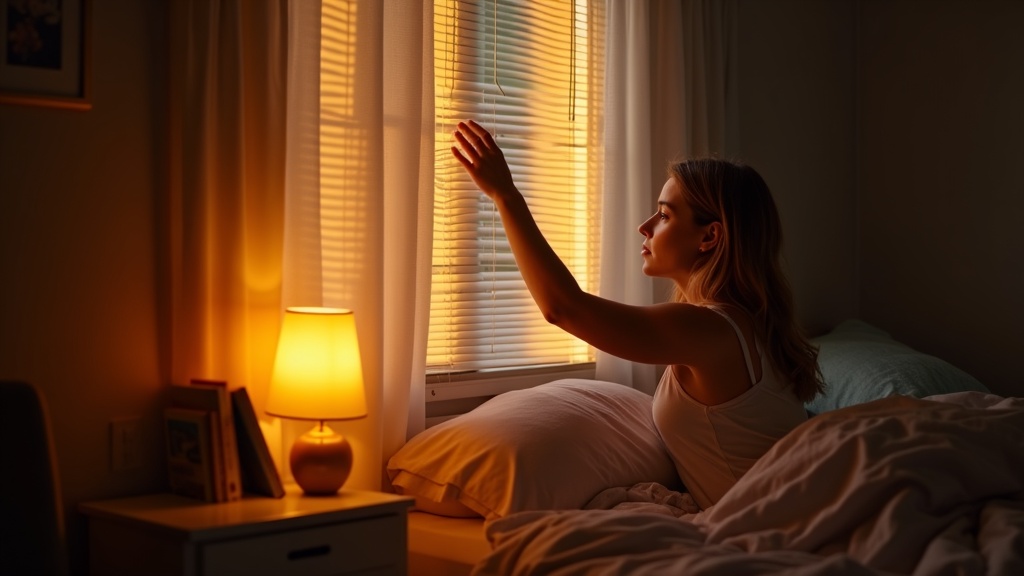
You don’t need to do anything complicated. Open your blinds as soon as you get up. Eat breakfast near a window. Take your coffee onto the porch. Walk the dog around the block. If you commute, try sitting by a window or walking part of the way. The goal is just to get some daylight on your face while your body is still waking up.
This doesn’t happen overnight. But if you make a habit of getting outdoor light in the morning, you’ll probably notice that mornings start to feel easier and your evenings naturally wind down sooner. Your body begins to expect the pattern.
Evening light can delay sleep, even when it doesn’t feel “bright”
Most people know that scrolling through their phone before bed can mess with sleep. But screens aren’t the only culprit. The ordinary lights in your home—overhead fixtures, bathroom vanities, even your kitchen lights during a late-night snack—can also nudge your sleep schedule later without you realizing it.
Your body expects darkness at night. When the sun goes down and light dims, your brain starts releasing melatonin, a hormone that makes you feel sleepy. It’s like a biological dimmer switch that helps you wind down. But melatonin is shy. It only shows up in significant amounts when your surroundings are actually dim.
Bright light in the evening tells your brain it’s still daytime, even if the clock says otherwise. This delays the melatonin signal and pushes your natural sleepiness later. The tricky part is that a light doesn’t need to feel blinding to have this effect. A well-lit living room or a bright bathroom can be enough to interfere.
Light temperature matters too. Cooler-toned light—the kind that looks white or slightly blue—is especially good at keeping you alert. That’s great for productivity during the day, but not ideal when you’re trying to relax at night. Warmer, amber-toned lights are gentler on your sleep system.
Even subtle sources add up. The glow from a TV in an otherwise dark room, for instance, creates a strong contrast that your eyes pick up on. It’s not about avoiding all light after sunset. It’s about recognizing that your body is listening to the light around you, and adjusting accordingly can make falling asleep easier.
Bedroom and home lighting choices can make evenings feel naturally quieter
The idea is simple: let your home get gradually dimmer as bedtime approaches. Your body notices the change and starts preparing for sleep without you having to think about it.
Start by switching off overhead lights a couple hours before bed. Use table lamps or floor lamps instead. The light stays lower, closer to where you’re sitting, and the room feels calmer. If your lamps are too bright, try lower-watt bulbs or add a dimmer switch. Warm-toned bulbs help too. They give off that soft amber glow instead of the harsh white light that mimics midday sun.
Here’s a useful rule of thumb: if it feels like daytime in your living room at ten at night, your body may treat it that way. The brightness tells your brain to stay alert, even if you’re tired. Dimming things down sends the opposite signal.
Your bedroom should be the darkest room in your home during the evening. If you need to read or get ready for bed, keep bedside lights low. A small lamp on a nightstand works better than a bright ceiling fixture. If you have tasks that need good lighting, like laying out clothes or organizing things for the morning, do them earlier in the evening when the rest of the house is still bright.
Think of it as creating a light taper, the way a river narrows before it reaches calm water. You’re not flipping a switch from bright to dark all at once. You’re easing into it, room by room, hour by hour. That gentle slope helps sleep feel less like a chore and more like something your body naturally wants to do.
Nighttime wake-ups are easier to recover from with the right kind of light
You wake up at 2 a.m. needing the bathroom. You flip on the overhead light, and suddenly your brain thinks it’s morning. Even a quick trip can make it surprisingly hard to fall back asleep.
Here’s what happens: bright light, especially the cool white kind most bathrooms have, tells your body to stop making melatonin. That’s the hormone that keeps you sleepy. Your brain interprets the light blast as a wake-up signal, even if you were only up for two minutes.
The good news is you don’t need total darkness at all costs. You just need to avoid that jolt of bright light that resets your system to daytime mode.
Motion-sensor night lights work beautifully for this. Place one in the hallway or bathroom, set to a warm, dim glow. You get just enough light to move safely without triggering your wake-up response. Some people keep a small red or amber night light plugged in, since those warmer tones are less likely to suppress melatonin than blue-white light.
If you need to use the bathroom light, try keeping it as low as possible. Some people leave the door mostly closed and use the crack of light. Others install a dimmer switch or use only a single low-wattage bulb at night.
The same goes for checking your phone if you wake up. That bright screen is basically a sunrise in your hand. If you absolutely need to look at something, turn the brightness way down and use a warm color filter if your phone has one.
The goal isn’t perfection. It’s simply giving yourself the best chance to drift back to sleep without accidentally telling your brain the day has started.
Your light habits can protect your sleep when your schedule changes
Ever notice how Monday morning feels brutal even after sleeping in all weekend? That groggy, disoriented feeling isn’t just bad luck. When you sleep until noon on Saturday and Sunday, you’re keeping your body in darkness during the hours it expects morning light. By Monday, your internal clock has drifted later, so waking up at 7 a.m. feels like getting up in the middle of the night.
The fix is simpler than forcing yourself out of bed at dawn every weekend. Just get some daylight within an hour or two of waking up, whatever time that is. If you sleep until 10 a.m. on Saturday, step outside by 11. Even fifteen minutes helps anchor your rhythm so it doesn’t slide too far off track.
The same principle works when life throws your schedule around. Had a late dinner with friends? Get morning light the next day as usual, even if you’re tired. It tells your body the day has started, which keeps tomorrow night’s sleep on schedule. If you know you’ll be out late, dim your lights earlier the night before to build up some sleep pressure in advance.
Evening workouts and social events are trickier because they happen right when your body wants to wind down. If you exercise or go out at night, keep the lights reasonably bright while you’re active, then switch to dim, warm lighting as soon as you get home. This gives your brain a clear signal that the stimulating part of the evening is over.
Seasonal shifts matter too. Winter’s early sunsets can make you feel ready for bed at 6 p.m., but getting some daylight during lunch or right after work helps keep your sleep time from creeping absurdly early.
Small experiments can show you what light is doing to your sleep
You don’t need fancy equipment to figure out how light affects your sleep. A few simple changes, tried one at a time for three or four days each, can reveal surprisingly clear patterns.
Start with morning light. Pick a time shortly after you wake up and step outside for ten to fifteen minutes. It doesn’t have to be sunny. Even a cloudy day delivers more brightness than indoor lighting. Do this consistently for a few mornings and notice whether you start feeling sleepy earlier in the evening or if getting up feels less groggy.
Next, try dimming your home earlier than usual. An hour or two before bed, turn off overhead lights and use only lamps or side lights. See what happens to that familiar feeling of tiredness. Does it arrive sooner? Does it feel more natural?
You could also experiment with one specific room. If you spend evenings in the living room, try keeping it darker while leaving other spaces unchanged. Or stop using bright bathroom lights after dinner and use a small lamp instead. Small shifts like these make it easier to tell what’s actually making a difference.
Pay attention to three things: how long it takes before you feel genuinely sleepy, how mornings feel when you first wake up, and whether your body starts waking naturally around the same time. You’re not hunting for perfection or trying to hit a specific bedtime. You’re just looking for patterns.
If something doesn’t seem to change anything after several days, that’s useful information too. Not every tweak works for every person, and noticing what doesn’t matter is just as helpful as finding what does.