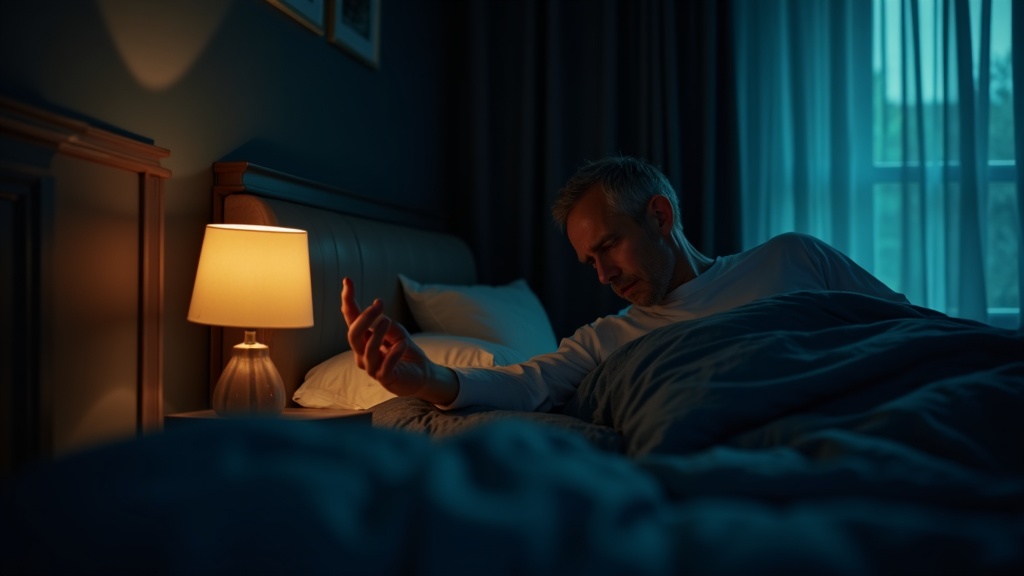
You’ve probably heard that screens before bed are bad for sleep. Maybe you’ve even invested in blackout curtains or banned your phone from the nightstand. But if you’re still tossing and turn or waking up groggy, the problem might be hiding in plain sight.
Your bedroom lighting does more than just help you see. It’s constantly sending signals to your brain about whether it’s time to be alert or time to wind down. And most of us have lighting setups that are accidentally working against us.
The tricky part is that these problems don’t announce themselves. You won’t feel your body fighting against the lamp on your dresser or the glow from your alarm clock. You’ll just lie awake longer than you’d like, or wake up feeling like you never really slept deeply. The connection between cause and effect stays invisible.
That’s because our bodies rely on darkness to produce melatonin, the hormone that makes us feel sleepy and keeps us asleep through the night. Even small amounts of light at the wrong time can interfere with this process. And modern bedrooms are full of light sources we barely notice anymore.
The good news is that once you know what to look for, fixing your bedroom lighting for sleep is surprisingly straightforward. You don’t need an expensive overhaul or a completely dark cave. You just need to recognize the signs that your current setup is working against you, and make a few targeted changes.
Your evening light looks crisp, white, or slightly blue
Stand in your bedroom at night and look around. Does the light feel sharp and alert? Does it remind you of being in an office or a bright bathroom? That’s a sign your bulbs might be working against you.
Many modern LED bulbs are labeled “bright white” or “daylight.” They’re designed to mimic the look of midday sun, which is fantastic for kitchens, workspaces, or anywhere you need to feel awake and focused. But in a bedroom at night, that same quality can make it surprisingly hard to relax. Your brain reads that crisp, slightly blue-tinted light as a signal that it’s still daytime.
This isn’t about the brightness alone. Even a dimmed ceiling light or a reading lamp can create this effect if it’s the wrong color. The light just feels wrong for evening, like something is slightly off. You might notice it especially with overhead LEDs, vanity bulbs around mirrors, or those sleek desk lamps people use for reading in bed.
The problem is these bulbs are genuinely good at what they do. They save energy, last forever, and make colors look accurate. So it’s easy to install them everywhere and assume they’re fine. But when you’re trying to wind down, that office-like quality keeps your space feeling awake and active instead of calm and cozy.
If your bedroom feels more like a dentist’s office than a restful retreat after dark, the color of your light is likely the culprit. Swapping to warmer tones in the evening can make a surprisingly big difference in how your room feels.
You can see a bare bulb or a bright hotspot from the bed
Here’s a simple test: lie down in your bed exactly how you sleep. Look around. Can you see any light source directly? A bare bulb in your bedside lamp, the bright panel inside a wall sconce, or the glow of an LED strip behind your headboard?
If the answer is yes, you’ve found a problem. Even if your room feels dim overall, seeing a light source directly keeps your eyes in alert mode. It’s like staring at a tiny campfire. Your pupils contract. Your brain gets a signal that it’s not quite time to shut down yet.
This isn’t about the room being too bright. It’s about where the light hits your eyes. A lamp with no shade sitting on your nightstand might cast a soft glow around the room, but if you can see the bulb itself from your pillow, it creates what’s called glare. That direct hit matters more than you’d think.
Common culprits include bedside lamps without covers, wall-mounted lights positioned right at eye level, and open doors that let hallway light pour straight into your line of sight. Sometimes it’s a mirror on the opposite wall catching a lamp and bouncing a bright spot right back at you.
The fix doesn’t have to be complicated. You just need to break that direct line between your eyes and the light source. Angle the lamp away. Close the door most of the way. Move the mirror. Add a shade. Small tweaks that block your view of the actual bulb can make a surprisingly big difference in how your body winds down at night.
Your night light is doing more than helping you find your way
Night lights seem harmless enough. They help you navigate to the bathroom at 2 a.m. without stubbing your toe or waking yourself up completely with overhead lights. But that soft glow keeping you safe might also be keeping you awake.
The problem isn’t that night lights exist. It’s that many of them cast more light than necessary, or shine it in the wrong direction. If your night light creates a visible pool of brightness on your bed or walls, it’s probably too bright. If you can see the glow when you close your eyes, or if it shines directly into your face when you roll over, it’s working against your sleep.
A truly dark room should feel fully dark once your eyes adjust. If your bedroom never quite gets there, even with your eyes closed for several minutes, ambient light is the likely culprit. Night lights are often the source, especially those cheerful plug-in ones that light up an entire corner of the room.
Motion-activated night lights create another issue. They’re convenient when you get up, but if they trigger every time you shift in bed or a pet walks by, you’re getting repeated bursts of light throughout the night. Each one can nudge your brain away from deep sleep.
Don’t forget about light coming from other rooms. Bathroom night lights and hallway fixtures often spill under the door, creating a bright stripe across your floor. That indirect glow still reaches your eyes and signals to your body that it’s not quite nighttime yet.
Tiny electronic lights are noticeable once the room is dark
You might not notice them during the day, but when you turn off the bedroom lights, those little electronic indicators suddenly become impossible to ignore. That tiny green dot on your phone charger. The glowing power button on your air purifier. The faint blue ring on your smart speaker. The red standby light on your TV.
These small LEDs seem harmless, but they have a surprising effect once everything else goes dark. Your eyes are naturally drawn to points of light. Even when you’re trying to sleep, your brain keeps registering them. It’s like having someone gently tap your shoulder every few minutes. You might not fully wake up, but you never quite settle into deep rest either.
The problem gets worse when you have several of these lights scattered around the room. A clock display on one wall. A router blinking on a shelf. A humidifier glowing near the bed. A power strip with its own indicator light on the floor. Each one pulls your attention in a different direction.
What’s strange is that multiple tiny lights can actually feel more disruptive than one slightly brighter, well-placed light. When points of light are scattered everywhere, your bedroom starts to feel less like a restful space and more like a dim cockpit. Your eyes don’t know where to settle.
If you wake up in the middle of the night, these lights can make you hyper-aware that you’re awake. Instead of drifting back to sleep naturally, you find yourself staring at that phone charger LED, suddenly very conscious of being conscious. That awareness alone can make it harder to fall back asleep.
Screens are your last light source before sleep
Think about what happens most nights. You turn off the overhead light. Maybe the bedside lamp goes off too. The room gets dark. And then you pick up your phone.
Suddenly your face is glowing in a rectangle of bright white or blue light. Everything else is dark, but that screen is pumping light directly at your eyes. It’s like holding a flashlight pointed at your face while trying to convince your brain it’s time to wind down.
You might notice a few telltale signs this is affecting you. After twenty minutes of scrolling, you feel more awake than you did when you first got into bed. Or you keep turning up the screen brightness because it’s hard to see in the dark room, which just makes the contrast worse. Some people realize they’re squinting or their eyes feel strained, but they keep watching anyway.
The pattern shows up in different ways. There’s the classic phone check after lights-out, just a quick look that turns into fifteen minutes. Or using a tablet propped on your chest as a makeshift TV. Some people fall asleep with a show playing, which means light flickering across their closed eyelids for hours.
The issue isn’t really about the content you’re watching or reading. It’s about the timing and the light itself. Your eyes are getting a strong light signal at the exact moment your body is trying to figure out whether it’s time to sleep. In an otherwise dark room, that signal gets even louder. The screen becomes the only thing telling your brain what time it is, and the message is decidedly not bedtime.
Outdoor light is sneaking in around curtains and doors
You might not notice it anymore, but your bedroom probably isn’t as dark as you think. After a few weeks in the same room, your eyes and brain stop registering the familiar glow that creeps in from outside.
Take a minute tonight to really look around. Is there a thin line of streetlight around the edges of your curtains? Does light pool under your bedroom door from the hallway? If you live near other houses, porch lights or motion sensors from next door can cast a faint glow through your windows all night long.
And if your bedroom faces the street, every passing car sends headlights sweeping across your ceiling. You might not fully wake up when it happens, but your brain registers it.
Here’s the thing: even if you feel like you can sleep through these light leaks, they’re still doing something. Your bedroom never quite feels like nighttime. There’s always a baseline level of brightness that keeps the space from feeling truly restful.
This matters even more if you’re a light sleeper or someone who wakes up easily in those early morning hours. When dawn starts to break and outdoor light begins filtering in, that little bit of extra brightness can be enough to pull you out of sleep earlier than you’d like. Your body reads the ambient light level as a signal, even when you’re not consciously aware of it.
The good news is that once you spot these light leaks, they’re usually pretty straightforward to address. But first you have to actually see them.





