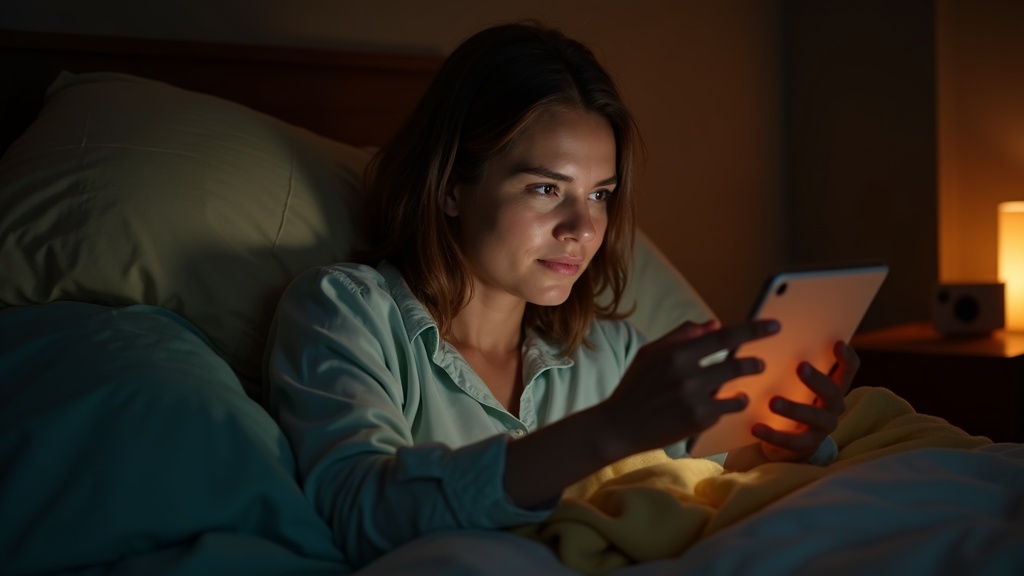
You know the feeling. You crawl into bed exhausted, but your brain won’t switch off. Maybe you scrolled through your phone for twenty minutes first. Or you watched a couple episodes of that show everyone’s talking about. Nothing extreme, just normal wind-down stuff.
Except you’re not winding down. You’re lying there feeling weirdly alert, even though your body is tired. When you finally drift off, your sleep feels shallow. You wake up groggy, like you never really rested.
The thing is, screens in the bedroom don’t mess with sleep in some simple, obvious way. It’s not just about staying up too late or getting overstimulated by what you’re watching. The problems are more subtle than that.
Your bedtime screen habits create a cascade of small disruptions. Some happen in your brain. Some happen in your body’s internal clock. Some are about what those glowing rectangles represent to your mind when you’re trying to rest.
The good news? Understanding how this actually works doesn’t mean you need to banish every device from your bedroom or swear off evening TV forever. It’s more about recognizing which habits are sabotaging your rest and which ones might be fine.
Because not all screen time before bed affects you the same way. The details matter more than the blanket rules.
A TV in the bedroom changes how you drift off and stay asleep
Many people swear by TV as their sleep aid. The low murmur of voices, a familiar show playing in the background—it feels like the perfect way to unwind. And sometimes it works, at least at first.
But TV has a sneaky way of keeping you up longer than you planned. One episode turns into two because the next one starts automatically. A movie runs twenty minutes longer than you expected. Before you know it, you’ve stolen an hour from your sleep without meaning to.
Even after you drift off, the TV doesn’t stop being a presence in the room. The light keeps flickering across your eyelids. Action scenes get louder. Commercials blast through at a different volume. Your brain notices these changes, even if you don’t wake up enough to remember them.
These little disruptions add up. You might sleep through them in the sense that you don’t sit up or open your eyes, but your sleep gets lighter and more fragmented. Your body never fully settles into the deeper, more restorative rest it’s looking for.
There’s another issue that builds up over time. If you always fall asleep with the TV on, your brain starts to expect that stimulation. Silence feels wrong. Darkness feels uncomfortable. You’ve accidentally trained yourself to need the noise and light, which makes it harder to sleep in other settings or when the TV isn’t available.
None of this means you have to banish your TV forever. But it’s worth noticing if your bedroom TV is actually helping you rest, or just keeping you company while your sleep quality quietly suffers.
Your bedroom learns what it’s for
Your brain is surprisingly good at learning patterns. When you do the same thing in the same place over and over, your mind starts to expect it. Walk into your kitchen and you might feel a little hungry, even if you just ate. Sit at your desk and your brain shifts into work mode.
The same thing happens with your bed. If you spend hours every night lying there scrolling through social media, watching shows, or answering emails, your brain starts to think of your bed as the place where you do those things. It stops being the sleep spot and becomes the entertainment spot instead.
This creates a weird problem when you actually want to sleep. You lie down, turn off the lights, and suddenly your brain is wide awake. It’s waiting for something to happen. You might feel the urge to grab your phone just to check one thing. Or you lie there feeling restless and alert, like something’s missing.
Some people find they can’t relax in bed without the TV on anymore. Others notice they get a little spike of energy the moment they climb under the covers, like their body is gearing up for screen time rather than winding down.
The good news is that this pattern isn’t permanent. Your brain can learn new associations just as easily as it learned the old ones. But it does mean that if your bed has become your everything space, scrolling station, movie theater, and office combined, you might need to help it remember what it’s actually for.
Screens can turn small wake-ups into long ones
Most of us wake up briefly during the night. It’s normal. Your body shifts position, you register a sound, and then you drift back down. The whole thing takes maybe a minute.
But when your phone is right there on the nightstand, that minute can stretch into twenty or forty. You tell yourself you’re just checking the time. Then you notice a few notifications. Maybe you swipe through messages or open one app, then another.
The problem is that your brain doesn’t stay sleepy while you do this. The light from the screen signals your body to wake up. Your mind starts processing whatever you’re reading. Suddenly you’re more alert than you were a few minutes ago, and falling back asleep becomes genuinely difficult.
The emotional side makes it worse. A work email that can’t be answered until morning. News that’s upsetting or enraging. A social media post that makes you feel left out or anxious. None of this is what your brain needs at three in the morning.
Even something seemingly harmless, like watching a quick video, can flip a switch in your head. You go from drowsy to engaged. Your heart rate picks up a bit. Your thoughts start moving faster. What was supposed to be a tiny interruption becomes a wide-awake session in bed.
The irony is that reaching for your phone often feels like the easiest thing to do when you can’t sleep. But it usually makes the problem bigger, not smaller. That brief moment of boredom or restlessness turns into a much longer stretch of wakefulness, all because the screen was within arm’s reach.
Small habit tweaks beat strict “no tech” rules
Most advice about screens in the bedroom sounds like a scolding. Put the phone away two hours before bed. No TV in the bedroom at all. Ban every glowing rectangle from your sleep space.
The problem is, plenty of people actually use screens to unwind. A few episodes of a familiar show can genuinely help you transition out of work mode. Scrolling through something low-stakes might be how you finally let your brain relax.
The trick isn’t eliminating screens entirely. It’s noticing which habits actually mess with your sleep and adjusting those specifically.
One simple shift: give yourself a natural last call for anything stimulating. If you’re scrolling social media or reading news, those tend to wind your brain up rather than down. Switching to something calmer about thirty minutes before you want to sleep makes a real difference. Think boring YouTube videos, a cozy show you’ve seen before, or an audiobook that doesn’t grip you too hard.
Dimming your screen as much as you can tolerate helps too. So does turning on do-not-disturb mode so you’re not getting jolted by notifications just as you’re drifting off.
If you use your phone as an alarm, you don’t need to banish it from the room entirely. Just keep it off the bed itself. A nightstand or dresser works fine. That small bit of distance makes it less tempting to grab it reflexively.
And if you can manage even five or ten minutes of totally screen-free time right before you turn out the lights, your brain gets a gentler landing. It doesn’t have to be meditation or a whole routine. Just brushing your teeth, setting out tomorrow’s clothes, or sitting quietly counts.
Make the room friendlier to sleep even if screens stay
You don’t have to banish every device to get better sleep. Sometimes just changing where things live at night makes a surprising difference.
Start with charging stations. If your phone charges across the room instead of next to your pillow, you’re less likely to grab it reflexively at 2 a.m. The same goes for tablets and laptops. When they’re not within arm’s reach, the friction of getting up often breaks the automatic habit.
Think about what you’re making easy. If the TV remote sits on your nightstand and your book is buried on a shelf, you’ve already decided what you’ll reach for when you can’t sleep. Swap that around. Put the thing you want to do in the easiest spot.
Brightness matters more than most people realize. A bright screen in a dark room hits harder than the same screen in a lit space. If you’re going to watch something before bed, keep a low lamp on instead of sitting in total darkness. Your eyes won’t have to work as hard to adjust, and the contrast won’t feel as jarring.
Sound spill is another quiet problem. If you fall asleep to shows or videos, the shifting volume and sudden noises can pull you out of deeper sleep even when you don’t fully wake up. Timers that stop playback after an episode help more than letting things run all night.
The idea isn’t to make your bedroom feel like a monastery. It’s just about making the path to rest a little smoother than the path to another scroll or another episode.





